
Wild fruit, vital fruit
The long road to self-fertile berry varieties – using the example of Mayberries/Firstberries® and golden currants/Fourberries®
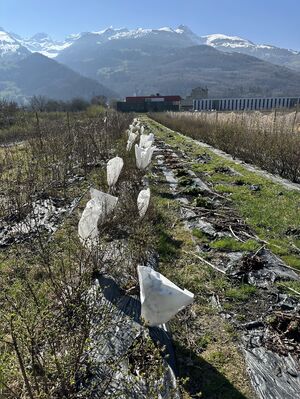
Contrary to popular belief, most plants (at least in an undomesticated state) are not self-fertile, i.e. they cannot fertilise themselves, but normally need a cross-pollinator, another variety of the same species. For cultivated plants or for plants that are to become cultivated plants, self-fertility is certainly a desirable characteristic. In this article, Markus Kobelt shows how Lubera® breeding attempts to obtain self-fertile varieties in Ribes aureum fruit varieties and in Lonicera...
Read moreHowunder® - Sambucus canadensis as a garden elderberry
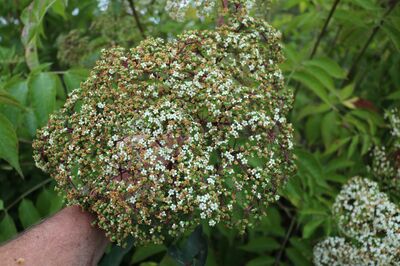
In addition to the black elderberry (Sambucus nigra), other species have great horticultural potential. Apart from the different native elderberry species used as wild and bird food trees, there is also the Canadian elderberry – sometimes also known as the American elderberry. In this article, we would like to show how the Howunder® – what we call the Canadian elderberry – can enrich any assortment and any garden.
Read moreHow do I put together my berry assortment?
Hopefully they are on holiday. Or even better, enjoy the fact that everyone else is on holiday. But once again, every plant producer is wondering which berry plants, varieties and assortments to choose for next spring. Because soon the young plants will have to be ordered. At Lubera Edibles, too, young plant production is controlled according to the order history and incoming orders. Later in winter or spring, you then have to take what is still available.
Read moreFor those who come too early...new data on berry demand AFTER spring
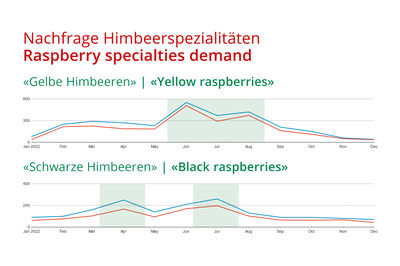
Traditionally, soft fruit plants are delivered to sales outlets and sold off in early spring. Depending on the season, there may or may not be additional deliveries. Using Google data, we show that the demand for certain types of fruit (or the corresponding terms) is sometimes continuous throughout the year or that there is a second peak after spring when the fruit in question is ripe. But can this effect also be demonstrated in specific plant sales? Are we perhaps systematically selling many...
Read moreThe demand for berry plants

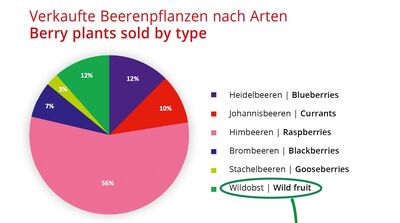
Actually, no one really knows the exact demand for berry plants. The market is too small for a statistically analysable survey to be worthwhile. By interpreting the sales figures of our online sister company Lubera.com for this small study, we can gain important insights into the natural demand for berry plants.
Read moreReal-time plant breeding – a breeding tour in April
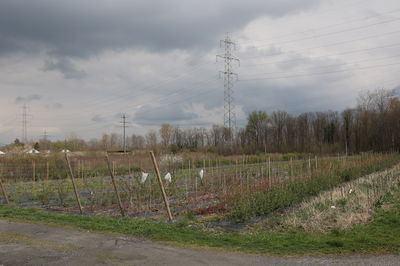
Plant breeding in April 2022: at Lubera’s field for plant breeding trials in Buchs, Switzerland in early April. You will look in vain for laboratories and white coats. Practical plant breeding takes place first of all in the field, then in the greenhouse; thirdly via researching and evaluating on the computer and only then perhaps in the laboratory. On a Sunday afternoon (when else?), I set off on a tour of our Lubera breeding field in Buchs. What do I notice? What is the latest news? What...
Read moreWild fruit breeding at Lubera®
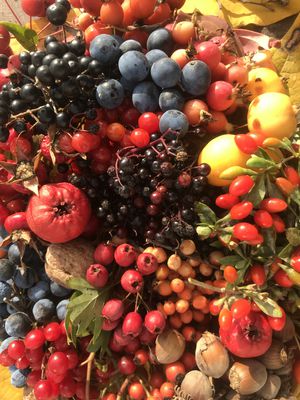
Unknown or little-known, hardly noticed fruit species are also worked on in the Lubera breeding programme. But why do we care about the obscure, little demanded, often not directly edible berry and fruit species, when we could possibly invest more in raspberry breeding? In this article, Markus Kobelt shows the importance of wild fruit species in the Lubera breeding programme and also describes in concrete terms the objectives for which research is carried out on the various wild fruit species.
Read moreMini kiwis – a plant portrait
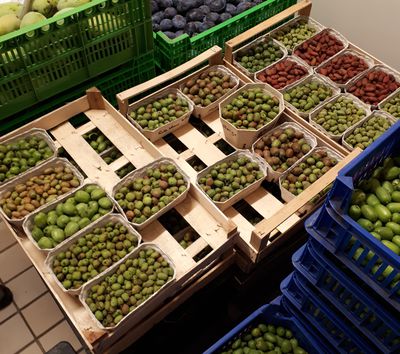
Who doesn't know the kiwi fruit from the supermarket? With its green or even yellow flesh and brown, slightly hairy skin, with its typical sour-sweet taste and exotic aroma?
But who knows the small-fruited relative of the kiwi fruit, the mini kiwi? Nurserymen and hobby gardeners, but also people interested in fruit will have heard of the mini kiwi, sometimes also called kiwi berry. But in the grocery store you will usually look in vain for them. If at all, the mini kiwi is only to be found in...
Read moreRoot power – a look into the future of rhubarb
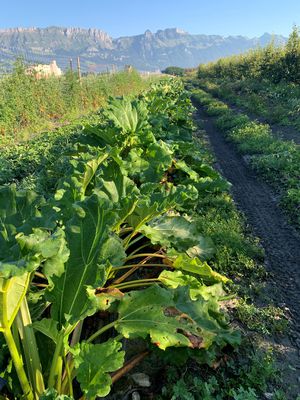
Looking into the future can be little more than looking into a crystal ball. What helps is to look back: rhubarb has a great past and history. There is a lot of future to be expected...not all rhubarb is the same – and a look at our candidate varieties from the Lubera® breeding programme shows what diversity even simple rhubarb is capable of.
Read moreThe beginning of ornamental raspberries – salmonberry young plants at Lubera Edibles

The salmonberry, botanically Rubus spectabilis, is a species originating from western North America with strikingly large and bright pink flowers. With its very special show of flowers and the edible raspberry-like fruits, the salmonberry offers real added value in any garden. That is why we have decided to include the following varieties in our range.
Read more