
 In vitro propagation is a regular topic of discussion in horticulture. Whilst it is an important component of reliable, high-quality young plant production for many businesses, others view it rather critically. Particularly in the organic sector and in European fruit growing, there are recurring reservations about this propagation method.
A closer look, however, reveals that in vitro propagation cannot be assessed in general terms. As with any propagation method, the results depend on the specific crop, the production objectives and the techniques employed. In this article, we demonstrate how we can use tissue culture to produce uniform, healthy and high-quality young plants almost all year round.
Summary
In vitro propagation enables the year-round production of healthy, true-to-type and uniform young plants whilst minimising the need for mother plants. High plant quality is ensured through controlled laboratory conditions and regular health checks.
Key advantages include high phytosanitary safety, good predictability and the ability to scale up production easily. Disadvantages include high investment costs, a need for highly skilled staff and long development times for difficult crops.
How quickly a crop can be scaled up depends heavily on the plant species: whilst raspberry production can be ramped up to over 100,000 young plants within around five years, more demanding crops such as red currants require significantly longer development times. The decisive factor is therefore not so much the method itself as the manageability of the crop in question.
Tissue culture process
To gain a better understanding of in vitro propagation, it is worth taking a look at the individual production steps. Each step contributes to ultimately producing healthy, true-to-type and high-performing young plants.
The raspberry serves as an example. This is because, more than 35 years ago, the raspberry was the first fruit-bearing plant species that we propagated in vitro. Today, it still accounts for around 50 per cent of all young plants produced by Lubera Edibles.
The mother plant
A key advantage of in vitro propagation is the low requirement for mother plants. Compared with other vegetative propagation methods, in vitro propagation requires only a small number of source plants to produce large quantities of young plants.
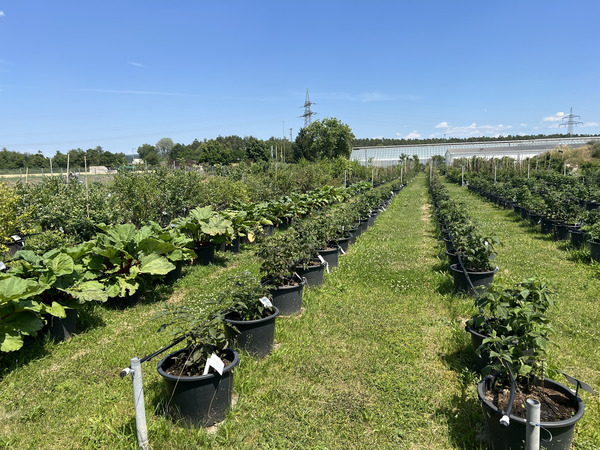
Picture: Mother plants for assessment and testing for true-to-type in Strullendorf
This enables us to provide intensive care for each mother plant and to safeguard its phytosanitary status through regular testing for key fungal, bacterial and viral pathogens. The mother plants are selected from Lubera’s breeding and selection fields in Switzerland. After being transferred to Strullendorf, Germany, the plants are tested and undergo additional pomological assessments to ensure long-term varietal purity.
The sister plant
A small number of so-called sister plants are established from the mother plants using root cuttings. These are intended solely to provide plant material as young as possible for the establishment of new in vitro cultures.
For this purpose, the plants are forced in early spring under controlled greenhouse conditions. The original mother plants are retained for further monitoring and variety testing.
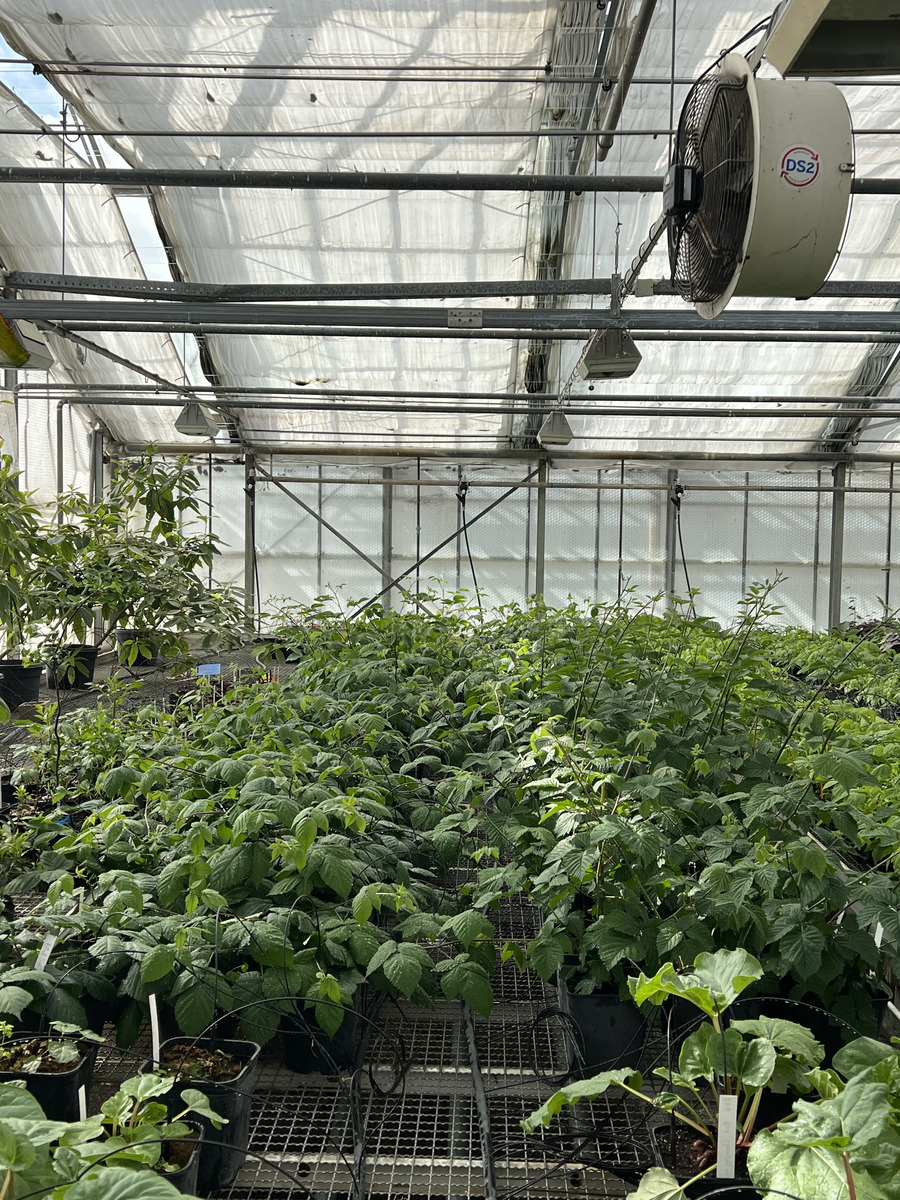
Picture: Sister plants used to obtain starting material for establishing in vitro propagation
Establishment of in vitro cultures
For raspberries, the meristems of fresh spring shoots are generally used for establishment. The young shoots are cut into individual nodes in the laboratory and then sterilised. This is necessary because a successful in vitro culture requires completely germ-free plant material. Even minor contamination by fungi or bacteria can jeopardise entire culture setups.
Removal of adhering fungi and bacteria by sterilisation
Choosing the concentration and exposure time of the sterilising solution is always a balancing act. On the one hand, microorganisms must be reliably removed; on the other hand, the sensitive plant tissue must not be damaged.
Sodium hypochlorite is usually used as a disinfectant. After treatment, the plant material is rinsed thoroughly to ensure no residues remain that could impair sprouting or further development.

Picture: Sterilisation process – shown here using rhubarb as an example
Whole nodes or prepared axillary buds?
Either whole nodes or prepared axillary buds can be used for establishment. The method chosen depends on the specific variety and previous experience. During preparation, the outer layers of tissue are removed under a microscope to expose the meristem.
Regular monitoring of the new starter cultures ensures that any potential infections are detected and isolated early. Otherwise, this could lead to total failure.
Nutrient medium for growth and propagation
The culture medium supplies the plants with all the necessary nutrients, vitamins and minerals. Since the young plants in the culture vessel can only perform photosynthesis to a limited extent, sugar is added as an additional energy source.
Growth regulators promote cell division and the development of new shoots. By regularly dividing and repotting the cultures, the plant material can be propagated in a targeted and controlled manner.
Scaled-up production
Once the plants have been successfully established, the actual production planning begins. The starting point is the desired delivery date. Based on the culture-specific propagation cycles, planning is carried out backwards to determine when and in what quantities in vitro material is required. This allows production capacities and delivery dates to be managed reliably.
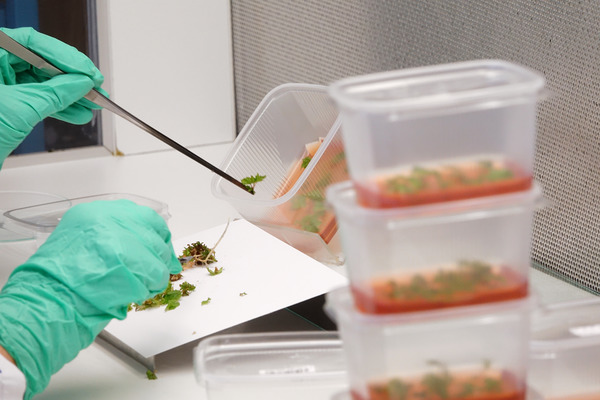
Picture: In-vitro plant propagation
Rooting phase
For most crops, rooting takes place in two stages. First, the plants are placed on a special medium that stimulates root formation. However, for most crops, actual root formation and development occur directly in the substrate. For this purpose, the plants are transferred to sterile substrate trays. Special plastic films ensure high humidity while simultaneously allowing controlled air exchange. Depending on the crop, this phase lasts between three and ten weeks. Wo 3 und wo 10 wochen?
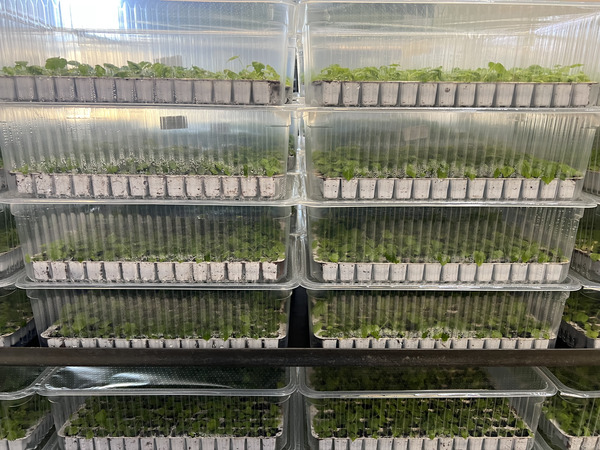
Picture: In-vitro trays during the rooting phase
Hardening-off phase
Once rooting is complete, the plants are gradually acclimatised to greenhouse conditions. To do this, the protective films are removed bit by bit. By removing the individual plastic films at staggered intervals, the initially still-tender cell tissue of the leaves can gradually harden until the leaf structure becomes robust enough for the plants to cope well with the greenhouse climate. In some cases, this very final step already takes place in the final young plant tray.

Picture: In-vitro tray with just one layer of film remaining; the first layer of film has already been removed to allow for better air exchange
Advantages of in vitro culture
- Low demand for mother plants
- Year-round production planning possible – independent of seasonal propagation windows
- High varietal purity through controlled mother plant stocks
- Consistent plant quality and homogeneous stocks
- Good scalability as demand increases
- High phytosanitary status through regular checks and tests
Disadvantages of in vitro culture
- High investment in laboratory and climate control equipment
- Highly qualified staff required
- In some cases, long lead times until new cultures are ready for production
- Not every plant species or variety can be propagated equally well
How fast is in vitro culture?
How quickly a new variety can be transferred to production via in vitro culture depends heavily on the plant species and variety. Some crops can be reliably scaled up within a few years, whilst others require significantly longer development and optimisation phases.
For this reason, the speed of in vitro propagation cannot be compared directly with other vegetative propagation methods.
Timeline for a simple crop – using the raspberry as an example (fast and reliable)
Raspberries are one of the most established crops at our company. Thanks to decades of experience and short propagation cycles, production can be scaled up relatively quickly.
| Year of development | Individual steps |
| Year 0 | Selection of the mother plant(s) |
| Year 1 |
|
| Year 2 |
|
| Year 3 | Confirmation of scalability: with up to 10,000 young plants |
| Year 4 | Up to 100,000 young plants, subject to confirmed scalability |
| Year 5 | > 100,000 young plants |
Timeline for challenging crops – using red currants as an example (slow and untested)
Red currants demonstrate that not every crop responds equally well to in vitro propagation. In this case, several years of development work were required to establish stable and reproducible protocols.
Development work on red currants is not yet complete. However, we are optimistic about the future and expect to achieve predictable and scalable young plant production in the medium term.
| Year of development | Individual steps |
| Year 0 | Selection of the mother plant(s) |
| Year 1 | Separation of the mother plants Phytosanitary testing Establishment of in vitro culture |
| Year 2 | Testing of existing protocols Adaptation of the protocols Test rooting of the first 100 young plants Evaluation of the individual test batches |
| Year 3 | Test rooting of the first 250 young plants based on the Year 2 trial evaluation Further protocol adjustments if necessary Evaluation of the individual test batches |
| Year 4 | Testing of reproducibility with 1,000 young plants based on the Year 3 trial evaluation Evaluation of the individual test batches Further protocol adjustments where necessary |
| Year 5 | Confirmation of reproducibility with 5,000 young plants |
| Year 6 | Re-confirmation of reproducibility with 10,000 young plants |
| Year 7 | Scalable production: > 20,000 young plants |
Conclusion
he examples given show that in vitro propagation also requires lead times. At the same time, however, it enables precise production planning, high plant quality and the reliable scaling up of new varieties.
Compared with other vegetative propagation methods, the timeframes often differ less significantly than is commonly assumed. What is far more crucial is how well the respective crop is managed in terms of production techniques. Or perhaps we should put it the other way round: if in vitro propagation can cover a very large number of crops, it simply makes the niche production of young plants for many varieties and species much easier. An equally important distinction is that one can start with just a single mother plant and does not first have to focus on large-scale mother plant production.
