
Two gardeners meet at the end of May. One says: ‘The year’s over; now we can finally focus on production – and we’ll hardly have any more trouble with customers.’ The other gardener counters: ‘No, it’s only just beginning. We’ve got another six months to make up for the setbacks and problems of the spring.’ Which gardener is describing the situation correctly? And which approach is more productive and promising? We’re happy to discuss this with our customers at our OpenDays. However, we’d like to set out a few points here in our Grower’s Book.
1. Demand for plants lasts longer than you might think
Half of our annual turnover is generated after spring.
At first, that sounds unbelievable. We once looked into how online sales are spread throughout the year at our sister company, Lubera.com. Do plant sales more or less stop with the arrival of spring? Or do we sell two-thirds in spring and, at most, one-third in summer and autumn? The result will surprise many gardeners
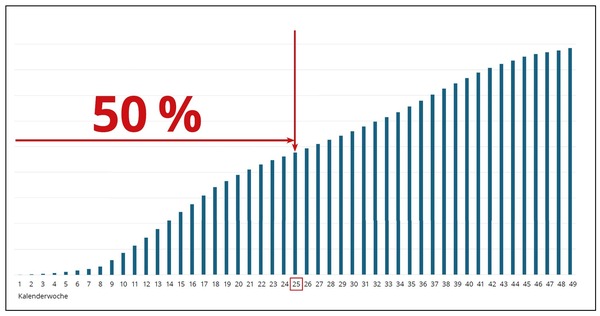
Chart: Cumulative weekly turnover at Lubera in 2025. The 50% mark was reached in calendar week 25.
In week 24 or 25 (depending on the year), Lubera.com achieves half of its annual turnover – in other words, almost exactly after the end of spring and at the start of the calendar summer. Of course, there are now almost endless reasons to dismiss this as a special case:
- Lubera.com sells online, so the barrier to placing an order is simply lower – at least compared to a distant DIY store or garden centre.
- Lubera doesn’t sell bedding or balcony plants, which naturally dampens spring turnover somewhat. But at least Lubera.com also offers a wide range of vegetable plants in April and May.
- I also often hear that it’s simply easier online to generate footfall and attract customers with special offers. As if that weren’t possible at physical retail outlets …
2. A question of attitude?
My son recently told me about a heated discussion following a professor’s lecture. The professor wanted to make it absolutely clear that it was the right processes that subsequently led to growth, revenue growth and profit growth. Some students, including my son, argued that an unwavering determination to grow was the most important prerequisite for growth – as only this mindset provides the drive to achieve growth targets. (Well, I’m rather proud of my son).😉
And here, when it comes to sales supposedly ‘off-season’, it’s exactly the same: if you don’t really want it and make it happen, it won’t work.
3. Prerequisites for increased footfall and sales in summer/autumn
So it’s clear: unless we shake off that spring lethargy, it won’t work. But what profession can really afford to bury its head in the sand – er, in the potting soil – for half a year? But what else is needed, apart from sheer determination, if summer and autumn sales are to succeed? I’ll list here, without claiming to be exhaustive, the four key ingredients of a summer and autumn strategy.
A. Benefits for the customer
Naturally, customers need to see the benefits of planting in summer and autumn. That goes without saying. In spring, the (spring) spirit drives planting; in summer and autumn, sound arguments must take over this role: grows better (raspberries); forms buds for next year’s yield (strawberries, fruit trees); fewer diseases in warm soil; treat yourself whilst others are on holiday…
B. Turn your advantages into the customer’s advantages
The grower has advantages too, after all. The summer plants were only potted a few weeks ago; they haven’t required much care; and – once sold – the grower doesn’t have to overwinter them. It makes sense, and is easy for customers to understand, if the grower passes on some of these benefits to them.
C. Advertising and footfall
If nobody’s visiting the website and only a handful of visitors disturb the deathly silence of the garden centre and the coolness of the DIY store (except on hot days…), then you won’t be able to make any sales. Even your sales pitches won’t get through, however good they may be. So somehow, enough people and pairs of eyes need to be drawn in: how about a beer after four, discounts, competitions or whatever else? A happy hour for gardeners?
D. Get rid of the old stock
Very often, old stock gets in the way of the summer sale. If there are only withered plants left standing around, nobody will enjoy shopping there. The same applies online: the summer sale only really takes off once we’ve made the transition from the old stock (= goods that are no longer visually appealing) to the new products – roughly from mid-July to early August.
