
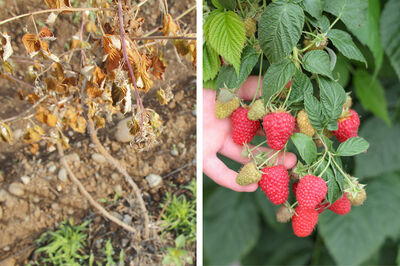
 Root rot (Phytophthora rubi and possibly other Phytophthora species) poses the greatest threat when growing raspberries. Here at Lubera, we estimate that around 50–70 per cent of enquiries and complaints regarding raspberry problems are directly or indirectly related to root rot.
In raspberry breeding, it is primarily the James Hutton Institute in Scotland that has so far taken systematic steps to improve the resistance potential of new varieties. Since the majority of international raspberry breeding is geared towards commercial cultivation, where plants are predominantly grown in pots – where the problem can be better controlled – only limited contributions towards solving the problem can be expected from this sector. Yet highly resistant varieties would also be of great interest for commercial cultivation, as they would enable a return to more extensive in-ground cultivation methods.
Supported by the Swiss Federal Office for Agriculture (FOAG) and in collaboration with Agroscope, the Swiss Agricultural Research Institute, Lubera has been working for two years to focus its own breeding programme more strongly on Phytophthora-resistant varieties as part of a practice-oriented research project. Partners in this project are Agroscope, the Swiss Agricultural Research Institute, and the James Hutton Institute in Scotland.
Summary
Root rot, caused primarily by Phytophthora rubi, is, in our view, the most significant disease affecting raspberries. We estimate that it is directly or indirectly responsible for more than half of all crop losses and complaints relating to raspberries. At the same time, breeding for resistance to Phytophthora has so far been pursued only to a limited extent worldwide.
Together with Agroscope, the James Hutton Institute in Scotland and with support from the Swiss Federal Office for Agriculture (FOAG), Lubera is therefore pursuing a new, systematic approach to developing Phytophthora-resistant raspberry varieties. The starting point is a genetic marker developed at the James Hutton Institute, which can identify the source of resistance in the Autumn Treasure variety.
The project combines four different approaches: the identification of genotypes suspected of having resistance within Lubera’s breeding programme; the genetic analysis of over 300 selections using the resistance marker; the verification of the results in field trials on infected plots; and the development of a reproducible infection test by Agroscope.
The objective is to identify, as quickly as possible, new raspberry varieties suitable for home gardens and professional cultivation that offer increased resistance to root rot. At the same time, the aim is to lay the foundations for combining multiple sources of resistance in the future, thereby further improving resistance over the long term.
Although research projects can never guarantee success, we are convinced that this multi-pronged and systematic approach creates the best conditions for sustainably mitigating what is perhaps the greatest vulnerability in raspberry cultivation.
Why do raspberry plants die?
We estimate that up to 60% of raspberry losses in home gardens are due to root rot. It also appears that more recent cultivation practices, particularly mulching with very thick layers, increase susceptibility to the disease. Under a thick layer of mulch, the soil remains damp and cool for longer – ideal conditions for the development of Phytophthora. The disease is much less likely to spread in warm and relatively dry soils.
A particular problem with root rot is that many gardeners do not recognise it as an actual disease at all. If a raspberry plant is growing poorly or individual canes die off, this is often attributed to drought, the plant becoming too old, nutrient deficiencies winter damage or cane blight. In fact, however, the cause often lies in the root system. As the disease remains hidden in the soil and the above-ground symptoms can vary greatly, its impact in domestic gardens is regularly underestimated. However, our experience from advisory services and handling customer complaints shows that Phytophthora is by far the most significant single factor causing damage in raspberry plantings.
Furthermore, the conditions for the disease in many modern gardens have improved rather than deteriorated. Whereas open soil used to dry out regularly in the summer, thick layers of mulch, intensive watering and humus-rich soil now ensure a consistently moist environment. These cultivation practices have many advantages, but they also create ideal conditions for the spread of Phytophthora. The disease is therefore not just a problem in poorly maintained gardens, but can also occur in very carefully tended gardens.
A third point should be added: in many gardens, trellises and supports are erected for growing raspberries in rows, and naturally, people wish to continue using them. Consequently, plants are often replanted in infected soil, which immediately causes them to die or fail to establish themselves.
Symptoms of root rot
The most typical and virtually unmistakable symptom becomes apparent in the planting when newly sprouting canes suddenly begin to die off. Initially, the tips droop; later, the entire young cane dies. At the same time, the two-year-old, fruit-bearing canes often begin to show signs of decline.
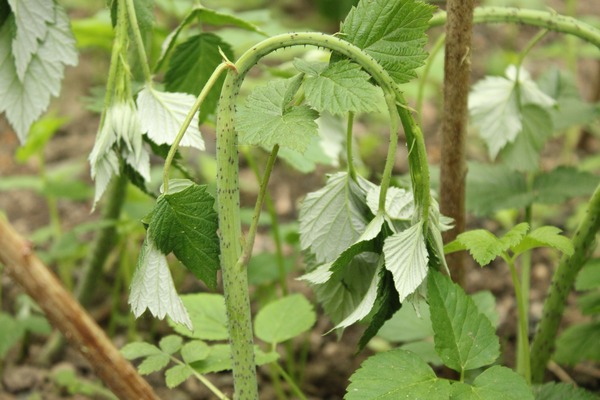
Picture: A clear early symptom: the young shoot is drooping.
In nursery production of young plants, there is also a significant risk of Phytophthora infection if hygiene standards are poor – for example, due to standing water on container beds or a lack of quarantine measures, or in the case of field propagation. Here, too, the young canes may be affected and subsequently die off. Mixed symptoms often occur, with young plants simply growing poorly in the spring and appearing generally unhealthy.
Various cane diseases must be distinguished from root rot. These usually manifest as delayed or weak bud burst in the two-year-old canes. Necrosis is often visible on the shoots, resulting from growth cracks that have allowed infection by various fungi. However, such cane diseases affect only the two-year-old canes; the new shoots are not directly damaged.
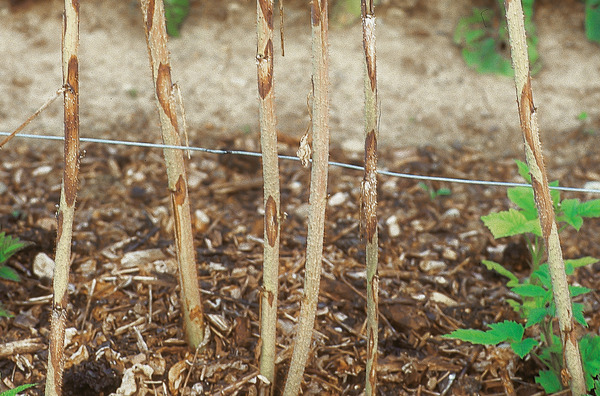
Picture: Typical symptoms of cane disease (Didymella) on two-year-old canes.
Well-known resistant varieties
Although root rot has never been the focus of intensive breeding efforts over the last twenty years, a number of highly tolerant or resistant varieties have emerged. These include the old North American summer raspberry Latham, the Sanibelle and Weirula varieties developed by Dr H. Schimmelpfeng in the 1980s (bred in Munich-Weihenstephan), and the English variety Autumn Treasure.
Are these varieties genetically related? Probably not. In any case, no clear genetic links can be established. In the case of Autumn Treasure, it is thought that the resistance originates in part from black raspberries, which feature in the variety’s pedigree. Dr Schimmelpfeng assumed that Sanibelle and Weirula were descended from Latham. After all, he had also bred Rubaca, whose pedigree is explicitly described as Rutrago x Latham…However, research carried out at East Malling was unable to confirm that Weirula and Sanibelle are descended from Latham. This suggests that these varieties may represent independent sources of resistance, just like Autumn Treasure and Latham.
Marker development at the James Hutton Institute
Researchers at the James Hutton Institute have developed a marker that can be used to detect the resistance inherited from Autumn Treasure. This will significantly speed up the process of breeding for resistance.
This work, combined with the ability to use the marker in our own breeding programme, now enables us to launch a concerted effort against Phytophthora and to develop Phytophthora-resistant varieties.
Initiative No. 1: Tracing Autumn Treasure’s legacy in our breeding programme
Thanks to our decades-long breeding collaboration with East Malling, Autumn Treasure has left a significant mark on our breeding programme. Many selections carry Autumn Treasure genetics. In some cases, these selections have already been used again as parents for new crosses.
This has enabled us to identify over 300 genotypes within Lubera’s breeding material that potentially carry the resistance genes from Autumn Treasure.
Initiative No. 2: Screening 300 genotypes using the resistance marker
Rather than observing these 300 selections in the field over a period of years, the marker developed by the James Hutton Institute allows us to carry out a much faster pre-selection. We can genetically analyse the genotypes and determine which ones actually carry the gene sequences believed to be responsible for resistance (marker-assisted breeding).
Initiative No. 3: Field trials on infested plots
Naturally, we want to be sure that our selection is indeed the right one and that the marker reliably predicts resistance. That is why Agroscope is testing the most advanced selections on naturally infested trial plots.
Initiative No. 4: Development of a reproducible Phytophthora test
At the same time, our project partner Agroscope is developing a reproducible Phytophthora test. In the past, root tests in aqueous solutions were primarily performed; however, they are difficult to perform and prone to interference. Agroscope is therefore working on a method in which potted plants are specifically infected with Phytophthora at the stem.
The future: Phytophthora-resistant raspberries?!
Why are we placing such a strong emphasis on breeding resistant varieties? Of course, certain improvements can be achieved by choosing a suitable site, implementing drainage measures or adopting appropriate cultivation practices. However, such measures have their limitations and can often only be implemented to a limited extent by hobby gardeners. Genetically anchored resistance, on the other hand, is effective in every plant, at every site, and over many years. It is therefore the most sustainable and economically viable form of plant protection.
In the long term, the development of highly resistant varieties could even lead to raspberries being grown more widely in the ground again, rather than in complex cultivation and container systems. Resistance breeding thus not only benefits the home garden but also opens up new possibilities for professional growers, enabling simpler and more resource-efficient production systems.
Using the four-step approach described above, it should be possible to identify raspberry selections that possess this resistance. If these results are further confirmed by field and pot trials, there is a chance that in the near future we will discover varieties that are of great interest to home gardeners.
Autumn Treasure is also an excellent parent and grandparent in raspberry breeding. At the same time, this project lays the foundations for significantly expanding resistance breeding against Phytophthora in a second phase. The aim is to combine various sources of resistance: the resistance of Autumn Treasure, the classic resistance of Latham and Winkler’s seedling, and the resistance of Sanibelle and Weirula, which has been confirmed in practice over the past twenty years or so.
In the long term, it would also be desirable to develop genetic markers for further sources of resistance.
How reliable will the results be?
Thanks to this four-pronged approach, we are confident that we are taking a significant step forward in resistance breeding. At the same time, science is always a process of learning. In applied research in particular, individual assumptions or findings may later prove incomplete or even incorrect.
For example, for almost twenty years we assumed that Weirula and Sanibelle had inherited their resistance from Latham – a hypothesis that ultimately could not be confirmed.
Thank you!
In our breeding work, we generally strive to remain as independent as possible and, above all, to enter into private-sector partnerships that strengthen our work. In this case, however, we have chosen a path that we could not have taken on our own.
Together with Agroscope, we therefore submitted a research proposal to the Swiss Federal Office for Agriculture (FOAG), which was approved and now enables us to pursue this comprehensive approach.
Our project partners at Agroscope are the Berries and Medicinal Plants Research Group, led by Dr Louis Sutter and Gil Carron.
We would like to thank the Swiss Federal Office for Agriculture and our research colleagues at Agroscope for their fruitful collaboration.
