
 How do you steer a breeding programme? How do you decide what to do – and what not to do? Where do you continue to invest, and where do you cut back? And which of Lubera’s breeding initiatives are likely to cause the biggest stir over the next two to ten years?
1. The guiding principles of Lubera breeding
We have described and emphasised this many times before: we breed primarily for the home garden. In doing so, we are guided by the four key qualities of our market: better flavour, easier cultivation, greater resistance – and, where possible, surprise and diversity.
Purely agronomic criteria such as yield, firmness, ease of picking or shelf life are not our top priority. Of course, we do take them into account in some large breeding programmes, particularly where varieties may also be developed for commercial cultivation. But our focus is, and always will be, the home garden.
In terms of how easily the direction of breeding can be influenced, plant breeding is perhaps best compared to an oil tanker. Abrupt changes of course are hardly worthwhile, because investments have already been made in long-term programmes over years and decades. It makes more sense to distinguish between projects and programmes.
Projects tend to be more temporary in nature. The aim is to achieve a specific goal, test varieties, perhaps carry out a series of cross-breeding trials, and then decide on the next steps. Programmes, on the other hand, are wide-ranging breeding initiatives that are carried out over years and decades.
On the one hand, this sluggishness is a problem – because of the high historical costs and the investments already made. On the other hand, it is also an advantage: knowledge, experience and genetic material accumulate over these decades.
Recently, for example, we learned that an apple parent variety we introduced 30 years ago carries interesting additional scab resistance traits. We then investigated which lines, varieties and breeding numbers we had accumulated over the past 30 years that also trace back to this variety. And lo and behold: in this way, we found half a dozen numbers and candidate varieties that carry these additional resistance genes…
Breeding can therefore only be influenced to a limited extent – except in the case of even smaller-scale and newly launched projects. The breeding “tanker” follows behind the pilot boat and tries to stay on course. But how does the pilot find the right course?
Three points are crucial for setting our direction:
- The home garden objectives defined above: resistance, fruit quality and the gardening experience, ease of cultivation, diversity
- The market potential of the relevant breeding programmes – whereby we should not just make big things bigger, but can also help small plant species to play a role in the garden in the first place
- An assessment of breeding potential and possible progress: in other words, what could be achieved with reasonable or even modest effort
This is broadly how our current priorities are determined. They are slightly fine-tuned at the micro level each year. Every four to five years, new priorities are then set – often through the formation of new partnerships.
2. Raspberries and blackberries
Raspberries and blackberries are our core area of expertise. Around 50 per cent of the young plants sold by Lubera Edibles come from this sector and belong to the Rubus genus.
Unfortunately, the East Malling Research Station in Kent, with which we entered into a partnership 15 years ago, has ceased its raspberry and blackberry breeding programme. However, over the past 15 years we have gained so much experience, genetic breadth and depth that we are well placed to lead the way in this field ourselves. In addition, one of the breeders from East Malling, Marzena Liska, has been working in the Lubera breeding programme for the past 15 months.
Within the raspberry and blackberry sector, three main areas can be identified that hold the greatest promise for the future.
2.1 Rubus hybrids
We are probably the only programme – or at least one of the first – in the West to have resumed hybrid breeding. We are currently beginning to evaluate the first Rubus hybrids, i.e., crosses between raspberries and blackberries.
Our guiding principle: a raspberry with the flavour characteristics of a raspberry, but with the physical characteristics of a blackberry. This means the calyx remains in the fruit and is edible. We also want to use hybrid breeding to generate surprises for ourselves and hobby gardeners – new plant types we hadn’t anticipated.
We are doing this because we are convinced that, when it comes to raspberries and blackberries, we must avoid becoming victims of our own breeding progress. This means the following: always working with the same genetics, which ultimately only allows for minor advances – advances that, in the end, no one in the home garden is really interested in anymore.
Gardeners want new plants that offer them clear benefits. And they also want something different. Not just the same thing all over again, only a little better. But something completely new and surprising.
2.2 Gamechanger® - The game-changing blackberries
We are seeking to build on the breeding breakthrough in primocane blackberries: ripe fruit from the current year’s canes from the start of August. We also intend to develop this new category of plants internationally. The latest research shows that primocane blackberries have a different genetic makeup to primocane raspberries. Furthermore, unlike raspberries, blackberries are tetraploid, meaning they have four sets of chromosomes. The trait for primocane fruiting is recessive and must therefore be present in both copies on all four chromosomes. As a result, potential cross-breeding will produce very few additional primocane varieties. It will therefore be necessary to use markers that enable us to make this specific selection (autumn-bearing or not) at an early stage within large populations.
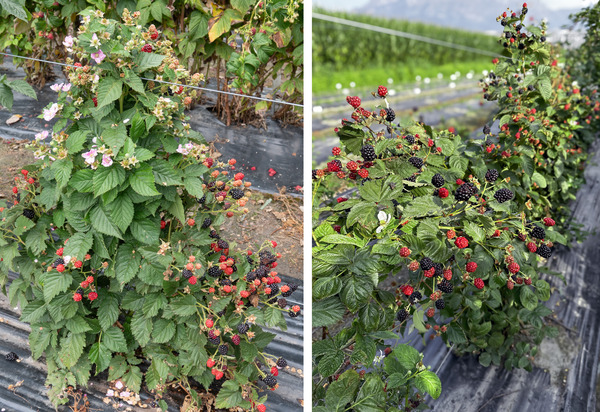
Picture: primocane Gamechanger® Black berreis are fruiting on this year canes
2.3 A multi-pronged approach to root rot in raspberries
We outline this breeding programme aimed at developing Phytophthora-resistant raspberry varieties in a separate article. Here, we are combining four different approaches to find a sustainable solution to the Phytophthora rubi problem in raspberries. This multi-pronged approach – that is, the use of four different test methods – is intended to ensure that we achieve our goal as quickly as possible. But what does “quick” mean in breeding? The answer is 5–10 years.
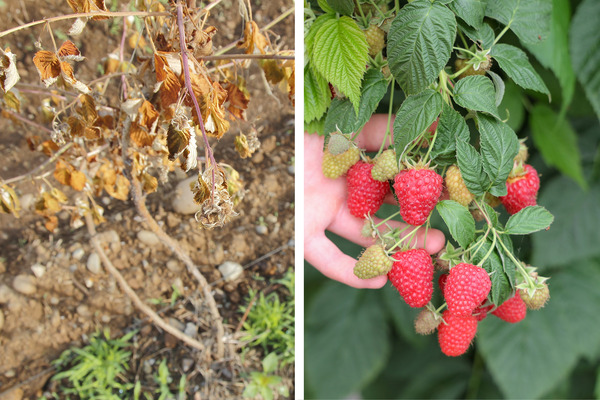
Picture: Root rot is by far the most common plant health problem affecting raspberries. Resistant varieties therefore greatly improve crop reliability.
3. Domestication and improvement of new berry fruit varieties
With the exception of hardy passion fruit, we are not working on entirely new berry fruit varieties here. However, we are working on what are known as “orphan fruits”: long-forgotten berry fruit varieties that have undergone very little breeding work.
One of the biggest obstacles to introducing such interesting berry fruit varieties into the garden is often self-incompatibility. In nature, this trait makes perfect sense, as it enhances offspring diversity and thus improves their chances of survival. In the garden, however, it is undesirable. This is because two different varieties must always be planted in order to have any hope of a fruit harvest.
Fortunately, this self-incompatibility is not entirely fixed. It is, admittedly, a barrier built into the plant that prevents it from accepting its own pollen, germinating it, allowing the pollen tube to grow, and finally fusing the male and female cells. However, one can expect one to two per cent exceptions – that is, one to two plants in every 100 that are more or less self-fertile.
These tests must then be repeated over a period of up to four years to rule out random results. And, of course, from this relatively small number of candidate varieties, only the best can be considered; however, alongside variety selection, it is also important to select self-fertile non-varieties that we can use later for further breeding. Ideally, we can then continue breeding with as broad a pool of self-fertile plants as possible, thereby sustainably anchoring this trait within the respective berry species.
We are currently doing this with Ribes aureum – that is, large-fruited yellow, orange, red to dark red Fourberries® – with the compact-growing Vaccinium angustifolium, with Lonicera caerulea (honeyberries, Mayberries or Firstberries), and finally, we are also working intensively on hardy passion fruit.
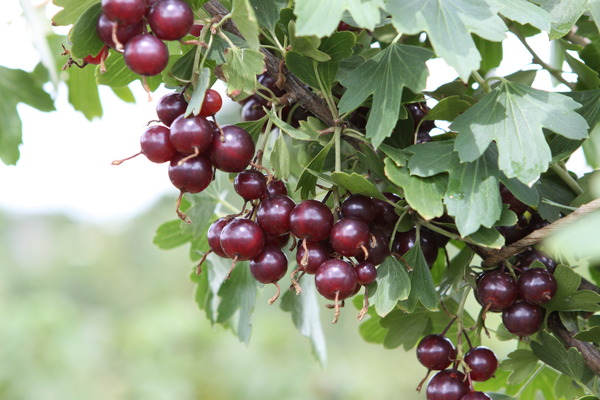
Picture: Self-fertility in Ribes aureum, the golden currant, would be a breakthrough for this species.
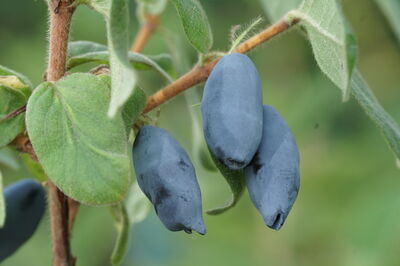
With honeyberries/Mayberries/Firstberries, a breakthrough in quality appears to be possible alongside self-fertility: highly aromatic varieties, no more bitter undertones, flavour notes ranging from blueberries to raspberries, and sugar levels from 18 to over 20 Brix. In this way, we can succeed in establishing this fruit variety in the garden in its own right.
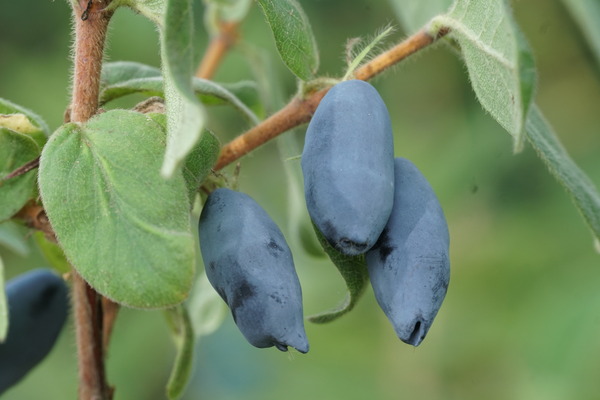
Picture: Among the Haskap selections, there are several self-fertile candidates on the horizon, which also represent a huge improvement in terms of berry quality...
4. And what about the classics – red currants and blueberries?
We have bred both varieties in the past, but far less intensively than we have with raspberries and blackberries. To gain momentum and breadth as quickly as possible – that is, within five to fifteen years in breeding terms – we have entered into a partnership agreement with the James Hutton Institute in Dundee, Scotland, for both species.
This agreement enables us to select from their plant collections and, in turn, use the selected varieties and genotypes for further breeding. At the same time, this also allows us to expand our own wealth of experience.
With blueberries, it will be crucial that we succeed in improving and customising not only the size but also the flavour and quality of the berries. Another line of development focuses on the long-term development of pH-tolerant varieties and variety-rootstock combinations.
With red currants, the objective is to breed larger fruits whilst improving sugar levels – and to eliminate the risk of powdery mildew. This is our goal: sweet varieties with a diameter of at least one centimetre. But of course, we’ll be more than happy just to achieve one of these goals.😉
5. Strawberries and fruit vegetables
We have been working for 30 years on improving vegetatively propagated fruit species. These are species that are propagated true to type using hardwood cuttings, root cuttings or tissue culture.
For just under 10 years, we have been gradually venturing into the uncharted territory of sexually propagated species: primarily fruit vegetables.
In the case of fruit vegetables, following our initial successes with outdoor tomatoes, we are currently developing a wide range of varieties for cucumbers, watermelons and sweet melons as well. The focus is always on varieties that can be grown outdoors without any problems and without the risk of disease. This spring of 2026, for example, we planted out around 20,000 vegetable seedlings, with the largest numbers being tomatoes and cucumbers.

Picture: a freshly planted plot in Buchs for testing outdoor tomatoes.
This is because, unlike breeding for commercial cultivation, our vegetable breeding does not take place in a greenhouse, but in the open field, where the plants are exposed to the natural pressure of fungal diseases and pests. That is precisely where they have to prove their worth.
An unexpected benefit of our long-term exploration of sexually propagated plants may lie in strawberry breeding. Here, we are considering how to transition to seed-propagated strawberry hybrid varieties, building on our existing garden and ornamental varieties.
6. Southern varieties
When asked what an overarching trend is in plants – and particularly in edible garden plants – we always mention southern plants.
As the climate changes, so do the ranges of plants available. Some plants are less well suited to the new climatic conditions, whilst others can suddenly be grown successfully in the garden.
We are not yet breeding very intensively in this area. However, we have set up large-scale, wide-ranging variety trials for a great many species: pomegranates, figs – with initial breeding trials already underway – hardy citrus, persimmons (with some breeding work already done), mulberries and others.
Some of these varieties will soon be incorporated into our range at Lubera Edibles, particularly the first Morus varieties from our own selection programme.
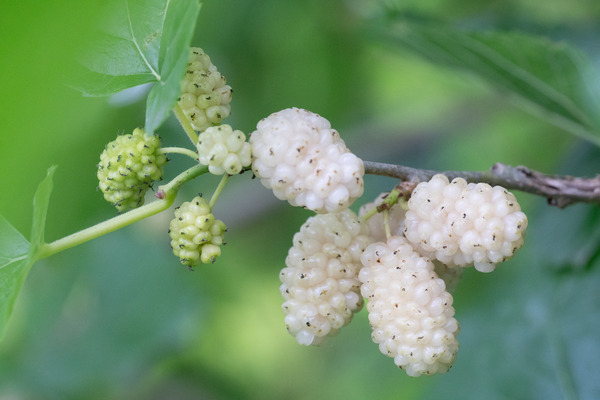
Picture: An interesting mulberry variety with white fruit from the trial plot in Buchs.
7. The list goes on
I did want to outline our main areas of focus. But of course, we do much more: at the moment, we’re conducting rather exotic breeding trials – with potatoes, for example, where we’re venturing into resistance breeding to compete with the big corporations (and not to put it too strongly: to give them a run for their money). On top of that, there are many small trials and projects that individual breeders – or even I myself – simply take part in.
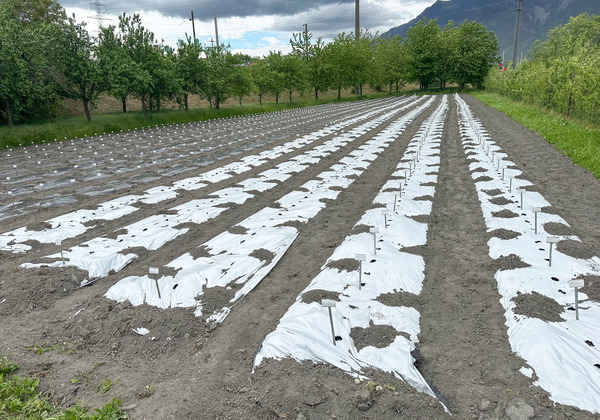
Picture: A newly planted potato field in Buchs with 1,000 varieties of potato...
And this aspect too – these excursions – is crucial. They broaden our wealth of experience, and we test new approaches that may well become major initiatives in the future.
Creative plant breeding thrives above all on a love of the craft, passion and thematic digressions. Yes, sometimes you’re even allowed to go a bit over the top.😉
