
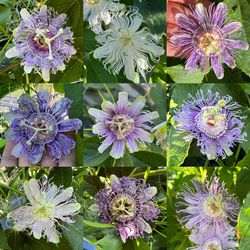
 Winter-hardy passion fruit that reliably flowers and fruits even in Central Europe – for a long time, this was considered a horticultural dream. However, Passiflora incarnata, originally native to North American regions with a pronounced continental climate and adapted to very hot summers and cold winters, has precisely the robustness needed for successful cultivation in Central Europe. In the Lubera breeding programme, we are working to adapt this robust wild species to the conditions of the Central European climate and the ever-smaller home gardens. The goal is this: winter-hardy passion fruit with good flavour that sprouts earlier, grows more compactly, is self-fertile, and ripens in late summer – perfect for modern edible and ornamental gardens.
Summary
Lubera is working to better adapt Passiflora incarnata to Central European home gardens. The species originates from regions with a continental climate and is therefore robust and frost-hardy – but it has high heat requirements, which leads to late sprouting and late fruit ripening, and still exhibits typical wild plant characteristics such as strong growth and a lack of self-fertility. In our breeding programme, we aim to identify passion fruits with a balanced, aromatic, and exotic flavour profile that sprout and ripen earlier, are self-fertile, and grow compactly. We are also working to increase pulp content, improve colour, soften the seeds, and extend shelf life. From over a thousand seedlings, we have selected those with a convincing flavour, that ripen early, and that are self-fertile. In a second stage, we examined the selections more closely, resulting in several candidate varieties.
Why is Passiflora incarnata the ideal candidate for hardy passion fruit?
Passiflora incarnata has a wide distribution across the south-eastern United States and a correspondingly high level of genetic variability. This diversity opens up great breeding opportunities, as the species produces edible and often aromatic fruits – whose quality can vary widely but which, overall, offer a promising starting point.
Unlike tropical passion flowers, Passiflora incarnata grows as a winter-hardy perennial: the above-ground part of the plant dies back completely in autumn, while the rootstock survives in the soil and reliably sprouts again in the spring. This adaptation makes the species extremely frost-tolerant; it can withstand temperatures down to around –20°C without difficulty.
Passiflora incarnata was already being used and cultivated in North America around 4000 years ago. In 1607, when founding the Jamestown colony, Captain John Smith described the agriculture of the Powhatan tribe, who cultivated and consumed the species. In his report, he compared the fruit to a pomegranate. Archaeological finds confirm that the species was widespread across large regions and was both collected and explicitly cultivated.
Our breeding goals for Cooltropics® winter-hardy passion fruit
Passiflora incarnata is still in the early stages of domestication and still retains (for us as gardeners) the negative characteristics of wild plants. In our breeding project, we are continuously working to improve winter-hardy passion fruit so that it is better suited to the Central European climate. We have therefore defined the following breeding objectives:
- Good flavour: The flesh should be aromatic and contain sufficient acidity in addition to a high sugar content. The aroma of our current varieties Cooltropics® ‘Snowstar’® and Cooltropics® ‘Eia Popeia’® is reminiscent of citrus and pineapple.
- Earlier bud break: Our current varieties sprout at the end of May. We want varieties that bud out 3-4 weeks earlier. However, sprouting too early before the beginning of May would be problematic due to the risk of late frost.
- Earlier fruit ripening: Current varieties ripen outdoors at the end of September. We want varieties that ripen as early as possible, ideally in August.
- Self-fertility: Our current varieties rely on cross-pollination. New varieties should also bear fruit without a second plant.
- Compact growth: New varieties should grow slightly weaker thanks to shorter internodes.
- Beautiful, large flowers: Our current varieties already delight with their magnificent flowers. However, the upcoming cultivars should impress with even larger, more impressive flowers that clearly distinguish themselves from existing varieties and add new visual diversity to the range.
- Seed hardness and size: For a pleasant eating experience, the seeds should be as small and soft as possible.
- Yield and fruit size: The fruits of the current varieties weigh about 30-40 grams. We have candidate varieties with significantly larger fruits.
- More aril (flesh around the seeds): The fruits should be well-filled and have a high proportion of pulp.
- Attractive colouring: In most cases, the fruits of Passiflora incarnata remain green even when ripe, and the aril is usually white to light yellow in colour. A yellow-coloured skin and an intensely coloured aril would make the fruits more visually appealing.
- Shelf life: Current varieties keep for about one week in the refrigerator. During this time, the aroma evaporates, the acidity breaks down, and the taste becomes stale, sometimes developing an unpleasant aftertaste. Some candidate varieties keep for several weeks without losing quality.
What do the Cooltropics® winter-hardy passion fruits taste like?
The most crucial criterion in breeding this new fruit variety is, of course, its taste. The fruit quality of Passiflora incarnata varies, but good-tasting passion fruits combine an aromatic, exotic flavour with juicy sweetness and a delicate, citrus-like acidity. The aroma can vary depending on the variety, degree of ripeness, and location; sometimes it is even reminiscent of strawberries, pineapple, or banana. For a balanced flavour profile, a high sugar content and a sufficiently high acidity are essential – if the acidity is lacking, the fruit quickly tastes flat and uninteresting. Our current varieties already have an excellent aroma. New variety candidates should at least match this level of flavour – or ideally even exceed it.
What characteristics does Passiflora incarnata need to thrive in Central European home gardens?
Its origin in a continental climate with summer heat and winter cold makes it fundamentally robust and frost-hardy. However, summers in Central Europe are often too short and too cool, so the plant does not always have enough time for the fruit to ripen. We want to further develop Passiflora incarnata so that it is optimally adapted to the Central European climate and to increasingly smaller home gardens. To achieve this, some characteristics still need improvement. This year, we have focused primarily on early ripening and self-fertility.
Early ripening passion fruit
The summers in Central Europe are usually milder and shorter in duration than those in the native habitat of Passiflora incarnata. Its growth begins only at relatively high temperatures – a protective mechanism against the bitter winter cold. In Central Europe, this means that the plant often does not sprout until the end of May, sometimes even as late as June. Before it can produce flowers and fruit, it must first build up sufficient leaf mass. The first flowers appear around four weeks after sprouting, and it takes another 90 days from flowering to harvest-ready fruit.
This results in the most important breeding goals: significantly earlier ripening and lower heat requirements, so that fruit can reliably ripen even in years with cool summers (such as 2025) and in regions with harsh climates. This year's wet and cold summer proved particularly helpful for selecting early-ripening passion fruit and offered ideal conditions for applying strict criteria. We defined the minimum requirement as the fruit having to ripen outdoors by mid-September at the latest. This year, only four selections met this criterion – presumably because they were planted out this year and were therefore not yet able to show their full potential.
Self-fertility
As home gardens are becoming smaller and smaller and often do not have enough space for two plants, an ideal Passiflora should bear fruit reliably even without cross-pollination.
The vast majority of Passiflora incarnata specimens are self-incompatible, meaning they cannot use their own pollen for successful fertilisation. Although the plant produces many flowers with abundant pollen, self-pollination does not usually result in fruit set. This is due to a genetically controlled mechanism that inhibits the growth of the plant's own pollen tube, thereby preventing self-fertilisation. This system ensures genetic diversity in natural populations, but makes it difficult to achieve reliable fruit yields in home gardens. For a reliable harvest, Passiflora incarnata therefore normally requires pollination by a genetically different second plant.
The vast majority of plants of this species are indeed not self-fertile, but there are a few exceptions. To find such rare individuals, we wrapped around 1,000 flower buds in fine mesh bags, thereby preventing insect pollination. Around 40 ripe fruits developed from this test; some buds fell off prematurely, while others were not filled or were poorly filled.
This self-fertility test is quite strict, as pollen can reach the stigma only on its own or by wind. We therefore assume that all plants that have set fruit are actually self-fertile and, with the help of insects in the garden, produce ripe fruit even without cross-pollination.

Picture: A wrapped bud

Picture: Fruit in a bag
Additional breeding goals
Once we have achieved these key breeding goals – early ripening and self-fertility – we will focus more on the remaining criteria:
- Compact growth: Many passion flowers grow very vigorously and form long shoots and extensive root runners. For home gardens, however, we need varieties that remain compact and form only a few runners.
- Seed hardness and size: For a pleasant eating experience, the seeds should be as small and soft as possible.
- Yield: Even though yield is less important in home gardens than in commercial cultivation, we want to develop varieties that produce a good, reliable harvest.
- More aril (flesh surrounding the seeds): The fruits should be well-filled and have a high proportion of flesh.
The current status of our Passiflora breeding programme
Three years ago, we sowed over 1,000 seeds of Passiflora incarnata. Most of the seeds came from plants growing on the northern edge of Passiflora incarnata's natural range, in states such as Illinois, Delaware, Pennsylvania, and New Jersey. The plants there are adapted to cooler summers and shorter growing seasons and should therefore also cope well with less heat in our climate. From this population, we selected plants that sprout particularly early, ripen early, and are also self-fertile.
In a second stage, we are testing the selected plants more closely. To this end, we have cultivated five specimens of each selection outdoors and three in a greenhouse and evaluated them according to the criteria described above. Several favourites have emerged from these tests, four of which we will present in more detail below.
Favourites and candidate varieties
PAS-24-101
An interspecific hybrid with beautiful, giant flowers that requires cross-pollination. There are over 50 fruits per plant, ripening from the end of August until the first frost. The sweet, exotic flavour has notes of passion fruit, banana, and citrus. The unripe fruits can be ripened and stored for up to a month.

Picture: Pas 24-101 flower

Picture: Pas 24-101 fruit
R-1-1
We were able to harvest ripe fruit from the R 1-1 selection as early as mid-August; it is self-fertile. This aromatic selection has a convincing flavour with a hint of citrus, and the seeds are medium-hard. The fruits are small but numerous. This variety will be available in small quantities from Lubera next year, with broader availability starting in 2027.

Picture: R 1-1 flower

Picture: R 1-1 fruit
H3 R-1-7
This selection ripens about two weeks later, the fruit is slightly larger, and it is also self-fertile. It also has an aromatic flavour with a hint of citrus. The fruit is medium-sized.

Picture: R 1-7 flower

Picture: R 1-7 fruit
R-3-12
This self-fertile selection ripens in mid-September. The fruit is large and pleasantly aromatic with a hint of pineapple.

Picture: R 3-12 flower

Picture: R 3-12 fruit
Overview of assortment and selections
| Variety |
Cooltrpics® Eiapopeia® |
Cooltrpocs® Snowstar® |
PAS 24-101 | R-1-1 | R-1-7 | R-3-12 |
| Taste |
**** Pineapple |
**** Pineapple
|
***** Banana, Citrus |
***** Citrus |
***** Citrus |
**** Pineapple, vanilla |
| Ripening | Mid-September | Mid-September | End of August | Mid-August | End of August | Mid-September |
| Bud break | End of May | End of May | Beginning of Mai | Mid-May | Mid-May | End of May |
| Self-fertility | No | No | No | Yes | Yes | Yes |
| Growth | Strong | Strong | Strong | Medium | Medium | Strong |
| Flower | Medium-sized, light Purple | Medium-sized, White | Very large, dark Purple | Medium-sized, dark purple | Medium-sized, light Purple | Medium-sized, light purple |
| Fruit size | Medium (30 g) | Medium (40 g) | Small (20 g) | Small (20 g) |
Medium (40 g) |
Large (70 g) |