
 The weather in 2025 has been quite challenging for gardeners so far. A mild winter gave way to a cool spring, followed by a spectacular start to summer with heat and weeks of drought. No sooner had we got used to it than daily rain showers and temperatures that did little to bring out the summer feeling arrived – only to jump back up to 30 degrees again.
Such capricious weather makes plant management in raspberry production a real challenge. That's why it's worth keeping an eye on the most important dos and don'ts.
First of all, the following points are general guidelines based on years of experience working with producers across Europe. They are no substitute for individual advice, but they can help you avoid pitfalls and optimise your cultivation practices.
Substrate selection – the basis for healthy plants
An entire book could be written about substrates. One thing is clear: choosing the right substrate has a direct impact on the success of your crop.
For raspberries, coarse porosity and very good drainage are essential. Especially in rainy periods, it is crucial to drain excess water quickly – raspberry roots are sensitive to waterlogging.
Whether the drainage effect is achieved with perlite, coconut fibre or other additives is secondary. What is important is the result: dry, well-aerated root zones.
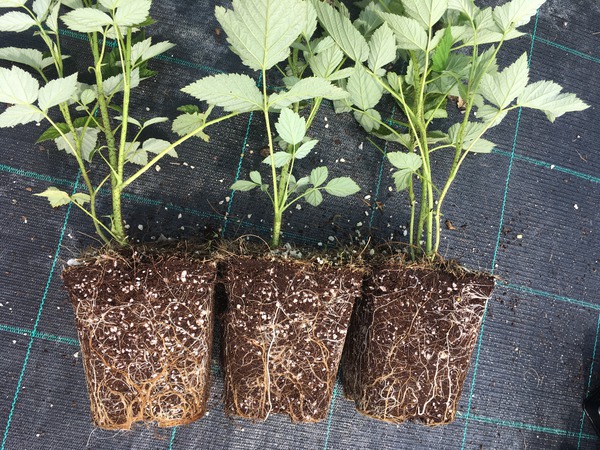
Picture: good root growth in a loose substrate – here with a significant proportion of perlite
Because raspberries have higher substrate requirements than many other crops, it is worth making your own mixture. Lubera, for example, has a substrate recipe specifically for raspberries – and we also take this approach in our young plant production. Anyone who has previously potted all crops in the same substrate should reconsider this approach.
Compost – a blessing with one small drawback
In times of peat reduction and peat-free substrates, compost is gaining in importance. It brings valuable microorganisms and nutrients into the substrate – which is good.
However, compost often also could contains a high proportion of fine particles. These fine particles can accumulate in the lower part of the pot during cultivation, thus restricting drainage. This is usually caused by leaching through irrigation water or rain.
Important: This is not only observed in compost-containing substrates. This phenomenon can also occur in mixtures without compost but with a high proportion of fine particles.
Substrate residues – don't just leave them lying around
We've all been there: after the last plant has been potted, there is substrate left over. The quick solution: order more young plants. But if the delivery takes weeks, the stored substrate can become problematic.
Depending on the composition, moisture and temperature, minerals can dissolve during storage and increase the salt content. This can be fatal for salt-sensitive young plants. Therefore, it is essential to measure the salt content before using stored substrate.
Watering – less is often more
Water is essential for plants. It does not matter whether the plant is growing in the ground or in a pot or container. The difference is that potted plants require regular watering. When watering, however, care should be taken to water as needed, if only to conserve resources. More importantly, most plants cope much better with too little water than with too much. However, excessive drought stress should also be avoided here. When it comes to raspberries, the rule remains: "Less is more!" The raspberries will thank you for it.
Pruning – timing is crucial
There are many philosophies when it comes to pruning raspberry plants – and they can all work as long as the result is right.
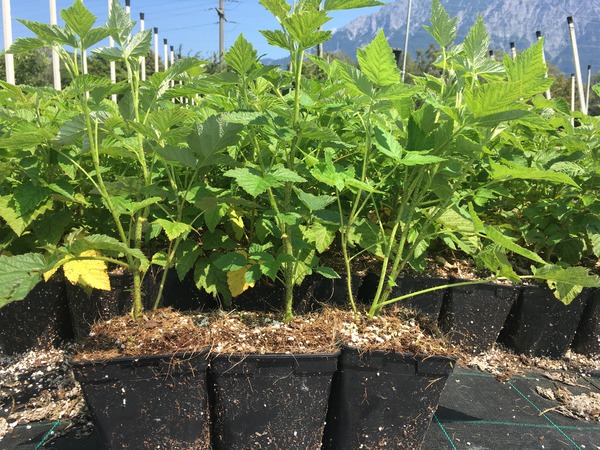
Picture: Here, the timing for cutting was perfect.
Nevertheless, a few rules of thumb are helpful:
- Better to prune too early than too late
- Never cut back completely – green, active leaves must remain
- After the beginning/middle of August, it is better not to prune heavily; only prune to shape for sale
These simple points avoid unnecessary stress for the plants and ensure good development until sale.
Mulching – an absolute no-no
Finally, the most important warning – because it is important to remember:
"Never mulch raspberry plants – neither in pots nor in the garden!"
A layer of mulch keeps the base of the shoots permanently moist and creates an ideal microclimate for harmful fungi and bacteria. This can result in the total loss of individual plants. So, to repeat, make sure you remember:
"Never mulch raspberries!"
Conclusion
Raspberries are demanding, but with the right cultivation methods, they are also rewarding. A coarse-pored, well-drained substrate, appropriate watering, careful pruning and avoiding mulch are the cornerstones for healthy plants and satisfied customers.
And if the weather decides to play tricks again? Then all you can do is stick to the dos and don'ts – and remain flexible.
