
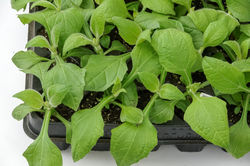
 In another article, we have already introduced you to the yacon (Smallanthus sonchifolius) plant group and have also described it in more detail. Now, in this text, learn all about our yacon young plant qualities and how you can produce high-quality pot/container plants for sale/trade from our yacon young plants.
Yacon young plants from Lubera Edibles
Like our other young plants of the vegetable group 'Fruits of the Roots®', the yacon young plants also come from micropropagation. Compared to plants from rhizome pieces, these types of yacon young plants have the advantage that micropropagated yacon young plants show a better and, above all, more uniform growth and a simultaneous start of growth. It also saves the long storage and tedious forcing of the rhizomes. In addition, the yield of micropropagation is much greater. Ultimately, 99% of the small young plants grow into saleable plants.
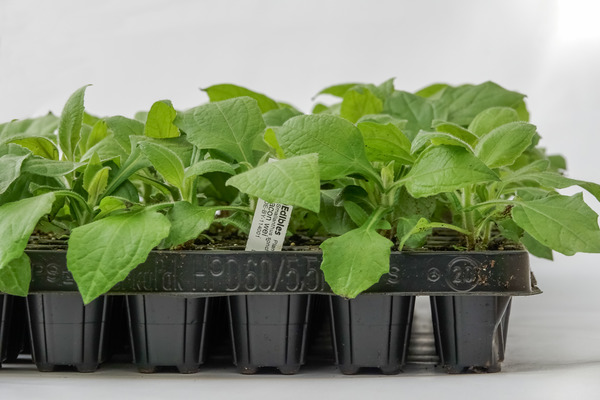
Picture: Yacon young plants in our 60-cell-tray
We offer our yacon young plants in 60-cell trays in the 'Multi' quality (annual). This quality of yacon young plants allows you a fast and smooth production of uniform and vigorous saleable plants. Already after about six weeks of cultivation (depending on the pot size) you can start selling the plants. We recommend larger pot sizes (12-19 pots) to underline the market value, because after all, more than 10 kg can be harvested per plant. This approach has already been successfully tested by our sister company with its online store 'lubera.com'.
How our yacon young plants become plants ready for sale
Similar to fruiting vegetables, our yacon young plants are only available seasonally in a short period of time and are offered in early spring exclusively as annual and herbaceous young plants. This seasonality (they should be planted by the end of May/beginning of June) is mainly also due to the five-month development period of the yacon plants at the end consumer.
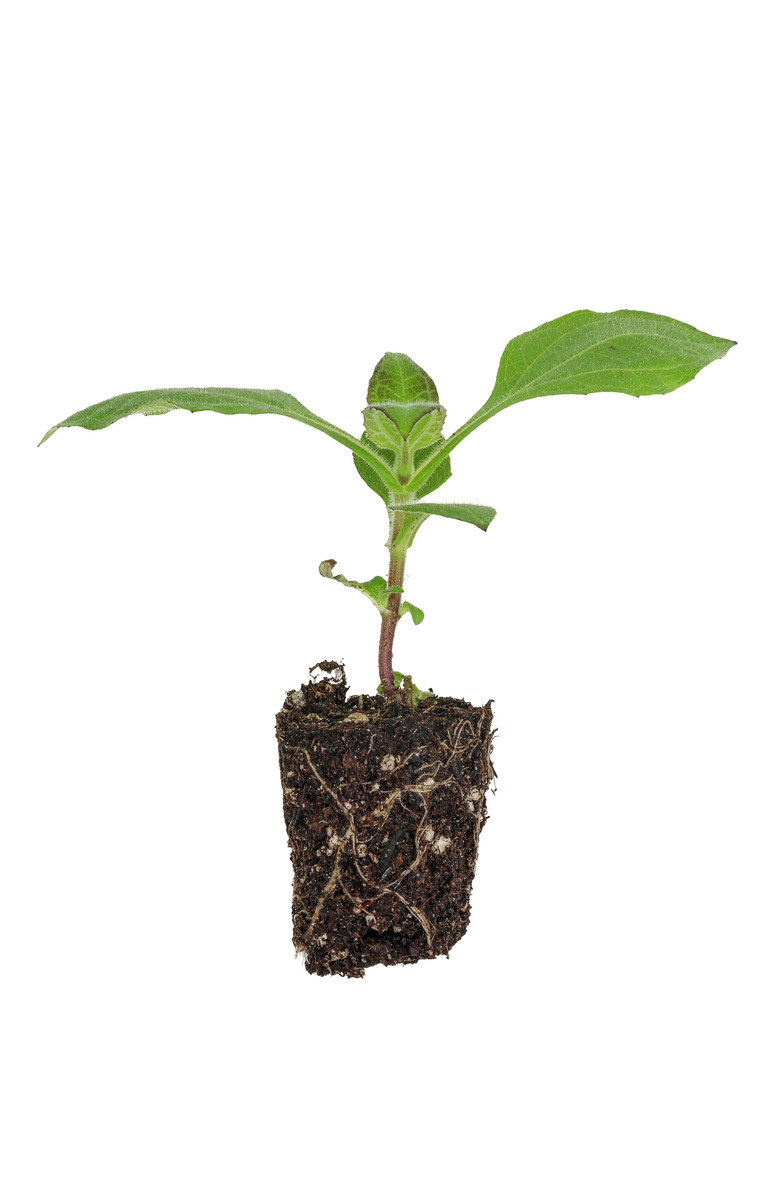
Picture: Single shot of ourYacon young plant
Below we show you an exemplary schematic cultivation sequence, based on our own experience when producing of yacon plants:
- Young plant quality: 60-cell tray in “Multi” quality (annual)
- Delivery time: week 14 – week 16
- Suitable pot size: 12 – 19 cm pots
- Substrate: normal potting substrate in slightly acidic range (pH value between 5.5 - 6.5)
- Location: tempered glass or plastic-covered greenhouse
- Cultivation time: 4 – 8 weeks (depending on the pot size and temperature)
- Time of sale: from the beginning of May (watch out for late frosts)
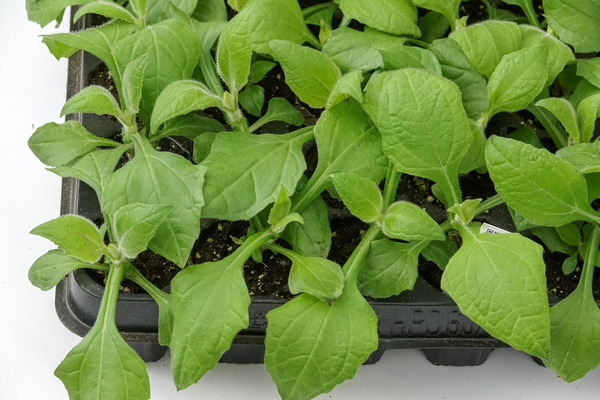
Picture: Yacon- young plants from the variety 'White Sweet'
The yacon varieties in our young plant assortment
After you have already learned everything about the origin, cultivation and advantages for the end consumer of this special tuberous vegetable in the first yacon article, we would now like to introduce you to our assortment of yacon young plants.
The main distinguishing features of the individual yacon varieties in the above-ground parts of the plant are on the one hand the height, which ranges from 1.2 m to 2.5 m, and on the other hand the shape of the leaves, which are broad and triangular to narrow, arrow-shaped. In the case of the subterranean plant parts, the varieties differ mainly in the outer tuber colour (colour of the skin). This ranges from creamy white to purple.
Yacon 'Red Sweet' – the red-skinned tuber sore
The red-skinned tubers of the yacon variety 'Red Sweet' are somewhat reminiscent of sweet potatoes in appearance. This variety has a slightly more vegetable flavour than its white-skinned sister variety. Therefore, this variety is more suitable for processing and as a cooked vegetable, but this does not mean that this variety cannot be eaten fresh.
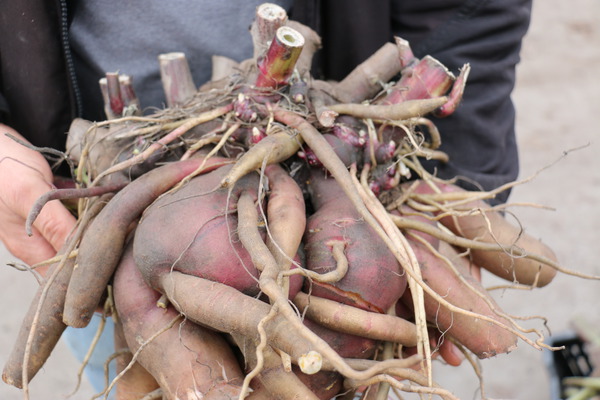
Picture: tubes of Yacon 'Red Sweet'
Short description of Yacon 'Red Sweet'
- Harvest: after the first frost, when the plants above ground are dead
- Tubers: red-purple colour of the skin (somewhat reminiscent of sweet potatoes)
- Taste: sweetish vegetable with a crunchy and juicy texture
- Growth: ≈200cm
Yacon 'White Sweet' – the white-skinned tuber variety
The white-skinned yacon variety 'White Sweet' is the sweeter tasting variety in our range. In addition, this variety is also somewhat juicier, making it more suitable for eating raw than its red-skinned sister variety – but it is particularly suitable for making juice and smoothies. Nevertheless, this is not to say that this variety cannot also be processed and cooked.
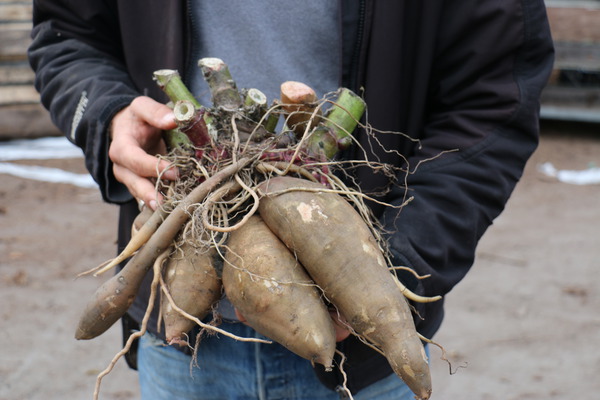
Picture: tubes of Yacon 'White Sweet'
Short description of Yacon 'White Sweet'
- Harvest: after the first frost, when the plants above ground are dead
- Tubers: whitish colour of the skin
- Taste: sweet, juicy with a crunchy texture
- Growth: ≈200cm
More articles about yacon
Read everything you ever wanted to know about this delicious tuberous vegetable in our other yacon article. Learn about its origin as well as its cultivation in Europe and all the tips and tricks for a successful harvest, including why yacon should not be missing in any vegetable plant assortment.
Yacon – the sweet, giant tubers from South America
And here you can find more articles about our 'Fruits of the roots®' assortment!
